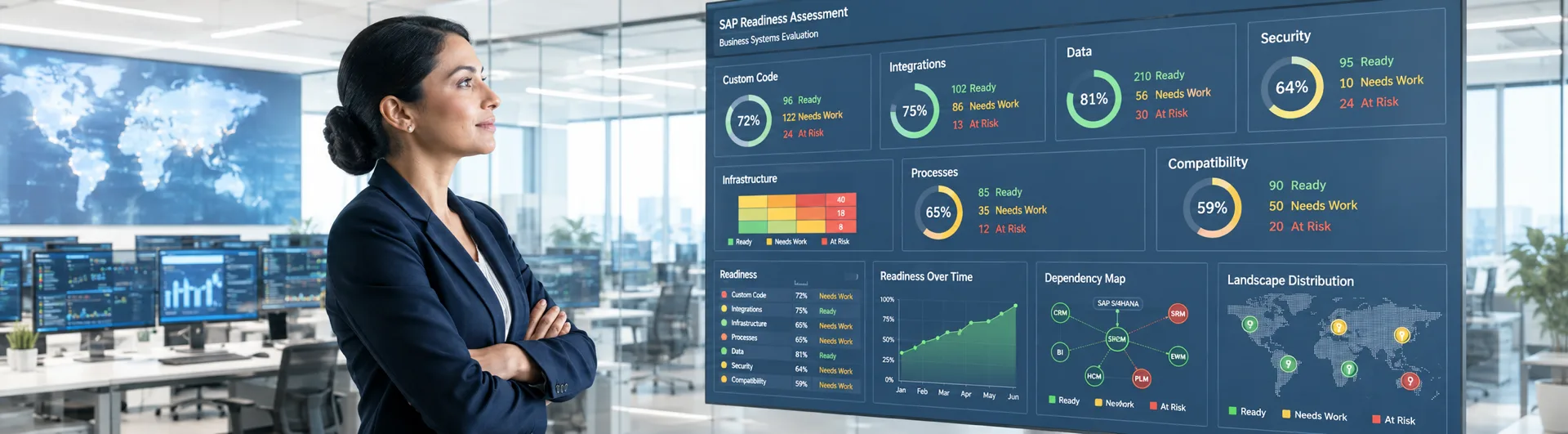
Pillar · Transform
Know Your SAP Cloud ERP Readiness
Identify risks, dependencies and priorities before committing to your transformation.
The challenge
A Tool Output Alone Does Not Define Transformation Readiness
Findings without business context
Readiness findings are not translated into business impact or priorities, and simplification items often lack owners, decisions, or due dates.
An incomplete technical picture
Custom code volume is known but its remediation complexity is unclear, interfaces and dependent systems are incompletely documented, and data quality risks surface too late.
Security and operations as an afterthought
Security and authorization impacts are treated as downstream activities, while infrastructure, operations, testing, and cutover readiness are assessed in isolation.
A readiness assessment must connect technical evidence to decisions, remediation actions, governance, budget, and transformation sequencing.
How we help
A 360° Assessment of Your Transformation Starting Point
We assess the technical landscape and the organization's ability to execute and sustain the transformation.
System & Architecture Readiness
We review the system version and maintenance baseline, add-on and compatibility fit, sizing and infrastructure considerations, landscape topology, and availability, backup, and recovery requirements.
Functional & Simplification Impact
We assess relevant simplification items, business process impact areas, mandatory functional decisions, Fiori and user experience implications, and process redesign opportunities.
Custom Code & Clean Core
We inventory custom objects and usage, review ATC and compatibility findings, identify remediation and retirement candidates, and classify extensions against a Clean Core risk baseline.
Data & Integration Readiness
We evaluate data volume and growth, data quality and archiving needs, the interface and middleware inventory, external dependencies, and migration object and reconciliation risks.
Security & Operational Readiness
We assess roles and authorization impact, security architecture and compliance gaps, technical operations readiness, monitoring needs, and testing, cutover, and continuity risks.
Program & Organizational Readiness
We evaluate governance maturity, resource and skill availability, the decision-making model, change and adoption considerations, and the transformation dependency map.
Business benefits
Replace Assumptions with a Prioritized Transformation Baseline
Early Risk Visibility
Expose technical and organizational risks before scope, budget, and timelines are locked.
More Accurate Planning
Estimate effort using actual findings across custom code, data, integrations, security, and operations.
Prioritized Remediation
Separate critical prerequisites from optimizations that can be sequenced later.
Stronger Business Case
Connect readiness gaps to investment needs, risk reduction, and expected business value.
Clear Ownership
Assign findings to accountable workstreams with decisions, actions, and target dates.
Faster Mobilization
Begin the transformation with an agreed backlog, dependency map, and governance structure.
Methodology
From Technical Evidence to Executive Action
Our assessment process combines automated analysis, expert workshops, and prioritized recommendations.
- 01
Prepare
Assessment plan, access checklist, stakeholder map
- 02
Discover
Landscape inventory, findings repository, dependency map
- 03
Analyze
Risk analysis, effort drivers, maturity scores
- 04
Prioritize
Remediation backlog, quick wins, decision log
- 05
Roadmap
Executive report, heatmap, roadmap, next-step recommendations
Engagement scenarios
Assessment Options Aligned to Your Transformation Stage
Initial SAP Cloud ERP Assessment
Establish a first fact-based baseline for an ECC-to-SAP Cloud ERP transformation.
Brownfield Conversion Readiness
Focus on technical conversion blockers, simplification items, custom code, data volume, and cutover risks.
RISE with SAP Readiness
Assess the additional architecture, responsibility, security, operations, and organizational implications of moving to the managed cloud model.
Selective Transition Readiness
Evaluate data scope, organizational changes, historical retention, and transformation tooling requirements.
Program Health Reassessment
Refresh readiness after delays, scope changes, acquisitions, landscape changes, or a transformation reset.
Why Global Core Technologies
Why Organizations Choose Global Core Technologies
Beyond Automated Reports
We interpret SAP tool outputs in the context of your systems, organization, and intended transformation path.
Cross-Domain SAP Expertise
Basis, architecture, security, development, integration, data, and governance perspectives are consolidated into one assessment.
Actionable Deliverables
Every material finding is tied to impact, priority, owner, dependency, and recommended action.
Executive and Technical Views
Leadership receives a concise decision view while delivery teams receive the detail needed to act.
Path from Assessment to Execution
Global Core Technologies can support remediation, roadmap development, program governance, migration, and ongoing operations.
Related services in this pillar
SAP Cloud ERP Transformation
Modernize your ERP landscape and prepare for the intelligent enterprise.
View service
RISE with SAP Advisory
Evaluate and structure your RISE with SAP journey with independent, business-led advisory.
View service
Migration Governance & PMO
Protect your SAP migration with independent governance and executive control.
View service
Clean Core Strategy
Reduce ERP complexity with a governed Clean Core strategy that preserves differentiation.
View service
Start Your Transformation with Facts, Not Assumptions
A structured readiness assessment gives your organization the clarity to define scope, reduce uncertainty, and build a realistic transformation roadmap.